
Why Flush Thresholds Fail in Brisbane Storm Events
Flush and zero-threshold doorways have become a defining feature of contemporary residential and multi-residential design in Brisbane.
They support:
seamless indoor–outdoor transitions
accessibility outcomes
clean architectural lines
Yet despite good intentions, flush thresholds are also one of the most common points of water-related failure during Brisbane storm events.
When issues occur, they are often attributed to doors, drainage, or construction quality. In practice, failures are almost always the result of design assumptions that do not align with how water actually behaves under local conditions.
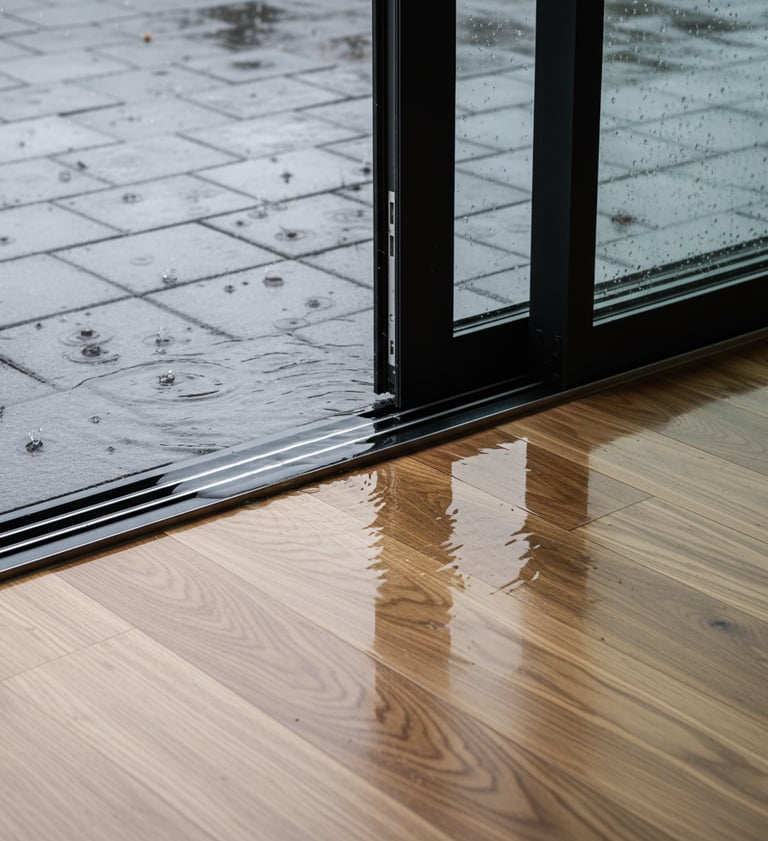
Flush thresholds reduce tolerance by design
Traditional threshold detailing relied on vertical separation to manage water.
Flush thresholds remove that buffer.
Once the internal finished floor level and the external finished surface are aligned:
the margin for error becomes extremely small
surface water behaviour becomes critical
minor deviations in level or fall have major consequences
In these conditions, the performance of the doorway is no longer independent of the surrounding surfaces. The threshold becomes part of a larger surface water system.
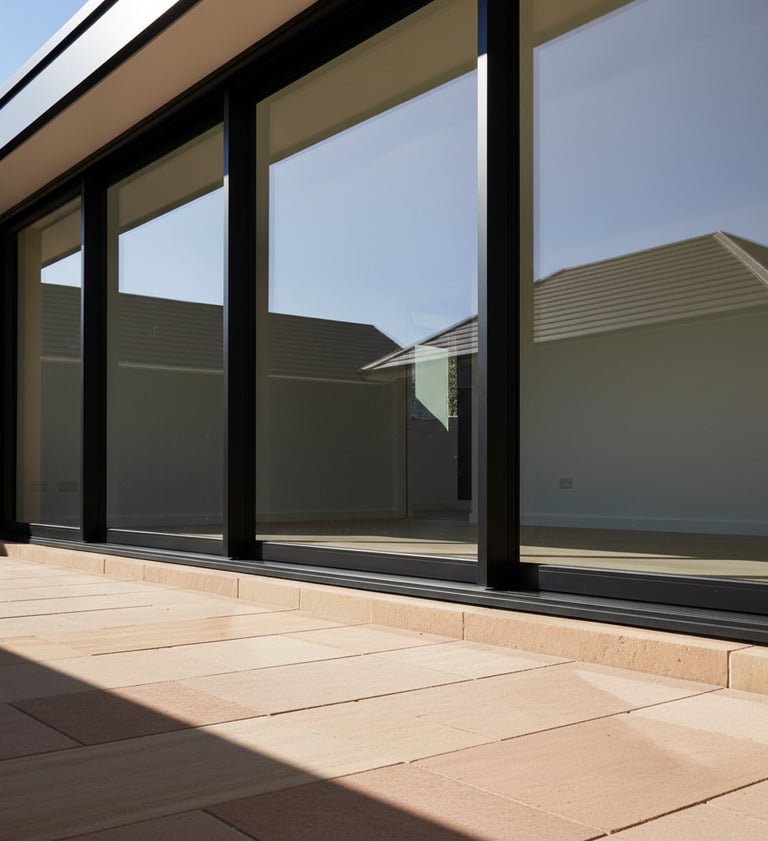
Brisbane storm events change how water behaves
Many threshold details are developed under assumptions that:
rainfall is primarily vertical
surface water volumes are moderate
ponding is short-lived
Brisbane storm events challenge all three.
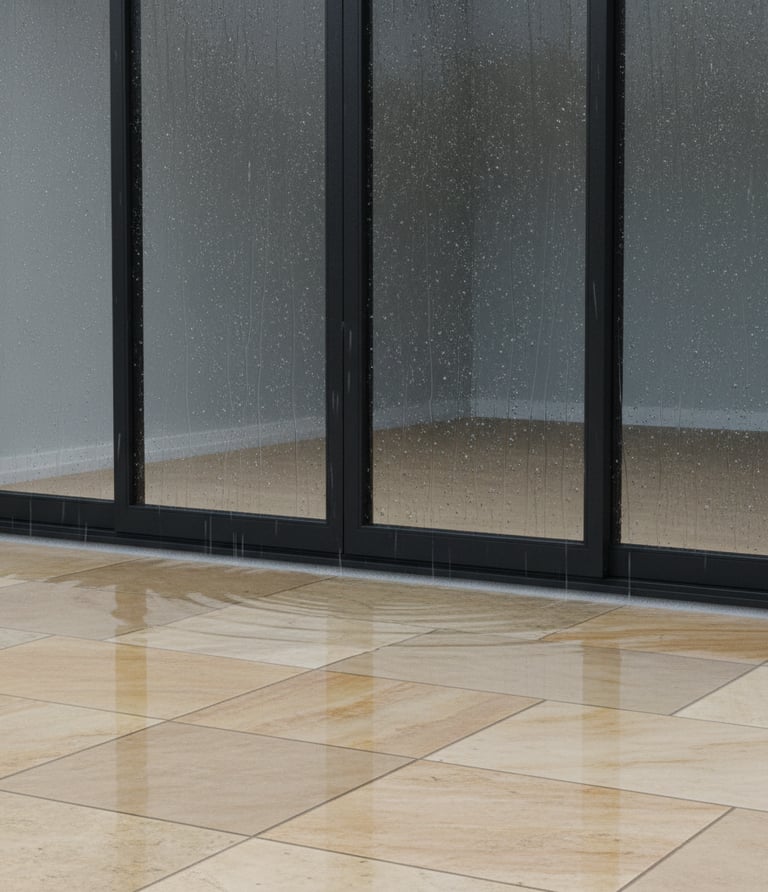
Short-duration, high-intensity rainfall combined with wind-driven rain means that water:
accumulates rapidly on external surfaces
moves laterally rather than vertically
reaches openings sooner and in greater volume than expected
Flush thresholds are particularly exposed because they rely on precise control of surface water, not containment.
Common design assumptions that lead to failure
Across Brisbane projects, flush threshold issues tend to trace back to a small number of recurring assumptions.
Minimal external fall is “good enough”
External surfaces are often designed with minimal fall to preserve aesthetics or meet level constraints. Under storm conditions, this fall is insufficient to move water away from the opening.
Drainage can compensate for level constraints
Drainage is sometimes expected to manage water that surface levels cannot. In reality, once water reaches a flush threshold, interception capacity is limited by geometry and level relationships.
Door ratings account for external water build-up
Door performance ratings assume that surface water is reasonably controlled. They are not intended to compensate for poor external surface water management.
Water will disperse before it becomes an issue
In Brisbane conditions, accumulation often occurs faster than dispersion, particularly where large paved areas drain toward an opening.
Flush thresholds are governed by relationships, not products
Flush threshold performance is determined by how multiple elements relate to one another, including:
internal finished floor level
external finished surface level
available surface fall
threshold geometry
anticipated water paths during storm events
When these relationships are compressed to achieve a flush appearance, the system loses redundancy. Water behaviour becomes predictable — and unforgiving.
This is not a matter of selecting the “right” door or adding components later. It is a coordination issue that must be resolved early..
NCC intent and the limits of interpretation
The NCC does not assume that water will be allowed to accumulate at building openings.
Its performance intent relies on:
surface water being managed externally
detailing that anticipates realistic environmental exposure
openings being protected by design, not by reliance on components alone
Flush thresholds often sit at the edge of this intent. Where aesthetic or accessibility outcomes override water behaviour, risk increases significantly.
Understanding intent — rather than treating thresholds as isolated details — is essential at design stage.
Why problems are difficult to correct after construction
Once construction is complete:
slab levels are fixed
external finishes are set
threshold heights cannot be increased
Retrofitting drainage or altering finishes rarely changes the underlying water paths. In many cases, these measures only reduce symptoms while leaving the core issue unresolved.
This is why flush threshold issues are so often described as “recurring” or “intermittent”. The behaviour was designed in.
The importance of design-stage review
Flush thresholds can perform reliably under Brisbane conditions, but only when water behaviour is considered deliberately and early.
Design-stage review is most valuable:
before slab and screed levels are finalised
when zero or near-zero thresholds are proposed
during coordination between architectural, waterproofing, and door details
when storm exposure and wind-driven rain are realistically assessed
At this stage, adjustments are still possible. After construction, options are limited
A quiet but critical distinction
Flush threshold failures are rarely dramatic at first.
They present as:
occasional water build-up
dampness near openings
issues only during heavy storms
Because they are intermittent, they are often dismissed — until a significant event occurs.
Understanding water behaviour before construction is the only reliable way to avoid this progression.
Further guidance
This article is intended to explain why flush thresholds commonly fail under Brisbane storm conditions.
For design-stage guidance on managing water at zero and flush threshold doorways — including level coordination, surface water behaviour, and Brisbane-specific exposure — see:
Contact
info@queenslandwateradvisory.com.au